Neuro-plausible Machine Learning — Past Projects
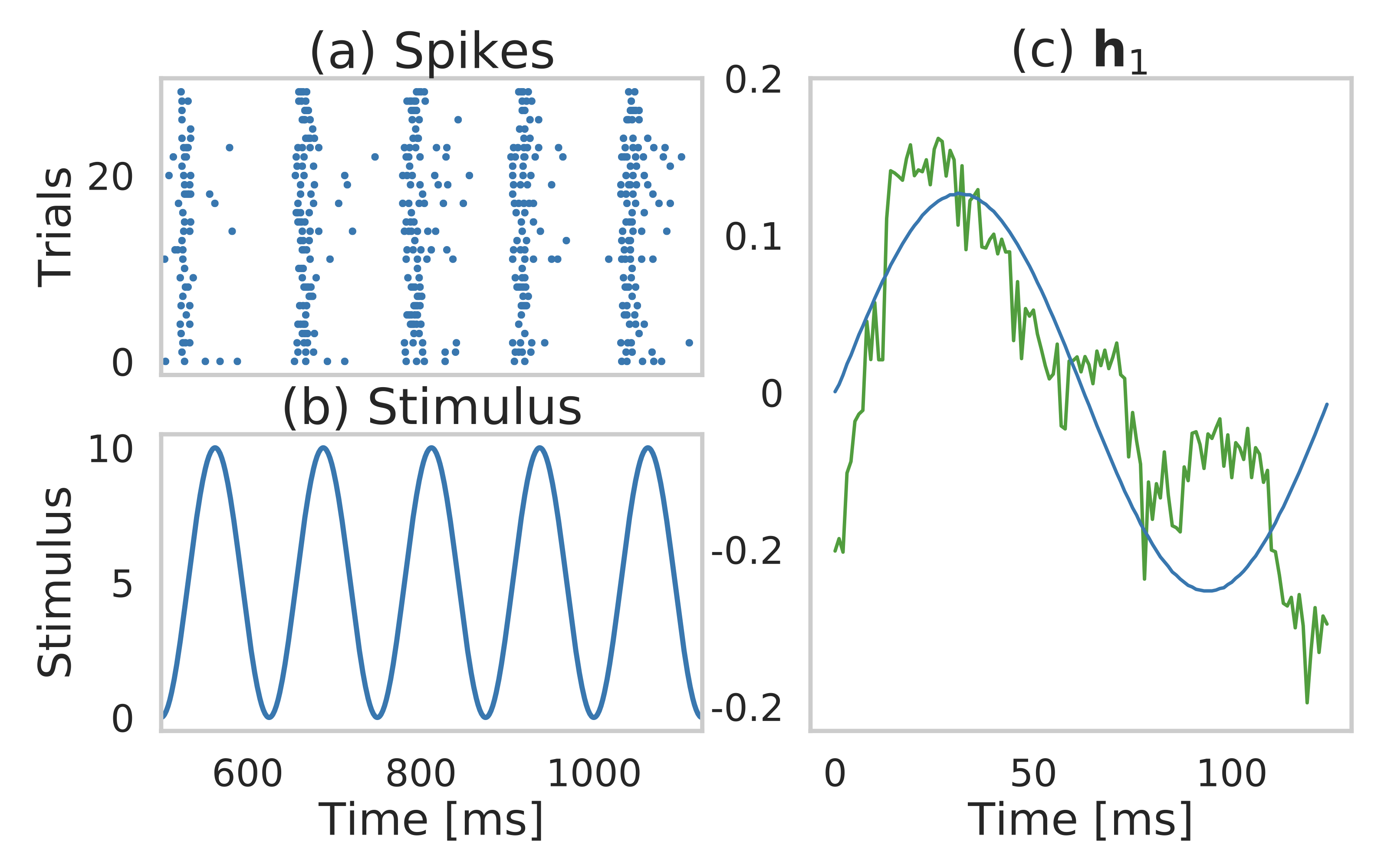
Learning stimuli via dictionary learning
The recording of neural activity in response to repeated presentations of an external stimulus is an established experimental paradigm in the field of neuroscience. Generalized Linear Models are commonly used to describe how neurons encode external stimuli, by statistically characterizing the relationship between the covariates (the stimuli or their derived features) and neural activity. An important question becomes: how to choose appropriate covariates? We propose a data-driven answer to this question that learns the covariates from the neural spiking data, i.e. in an unsupervised manner, and requires minimal user intervention. We use neural spiking data recorded from the Barrel cortex of mice in response to periodic whisker deflections to obtain a data-driven estimate of the covariates that modulate whisker motion.
Relevant papers
[1] Tolooshams B.†, Song A.†, Temereanca S.,
Ba D. "Auto-encoders for natural exponential-family dictionary learning", International
Conference on Machine Learning, 2020.
[2] Song A. †, Tolooshams B.†, Temereanca S.,
Ba D. "Convolutional dictionary learning of stimulus from spiking data", Computational and
Systems Neuroscience, 2020.
Main researchers: Bahareh Tolooshams, Andrew Song
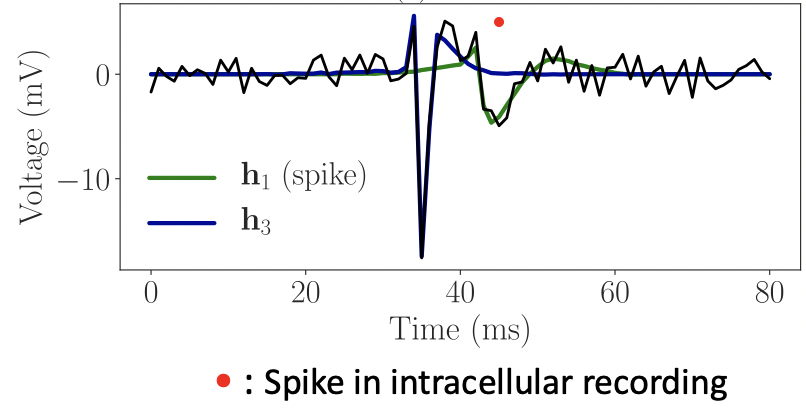
Spike sorting using dictionary learning
Decades of research in experimental neuroscience suggest that neurons communicate through spikes, which emphasizes the importance of accurate spike sorting from raw electrophysiology data. In these projects, we cast the spike sorting problem as a convolutional dictionary learning problem and suggest 1) optimization-based 2) autoencoder-based approaches. We demonstrate that not only these frameworks yield more accurate results compared to the baselines, but also are much more computationally efficient.
Relevant papers
[1] Song A., Flores F., Ba D. "Convolutional dictionary learning with grid refinement", IEEE
Transactions on Signal Processing, 2020.
[2] Tolooshams B., Dey S., Ba D. "Deep residual auto-encoders for expectation
maximization-inspired dictionary learning", IEEE Transactions on Neural Networks and Learning
Systems, 2020.
Main researchers: Andrew Song, Bahareh Tolooshams
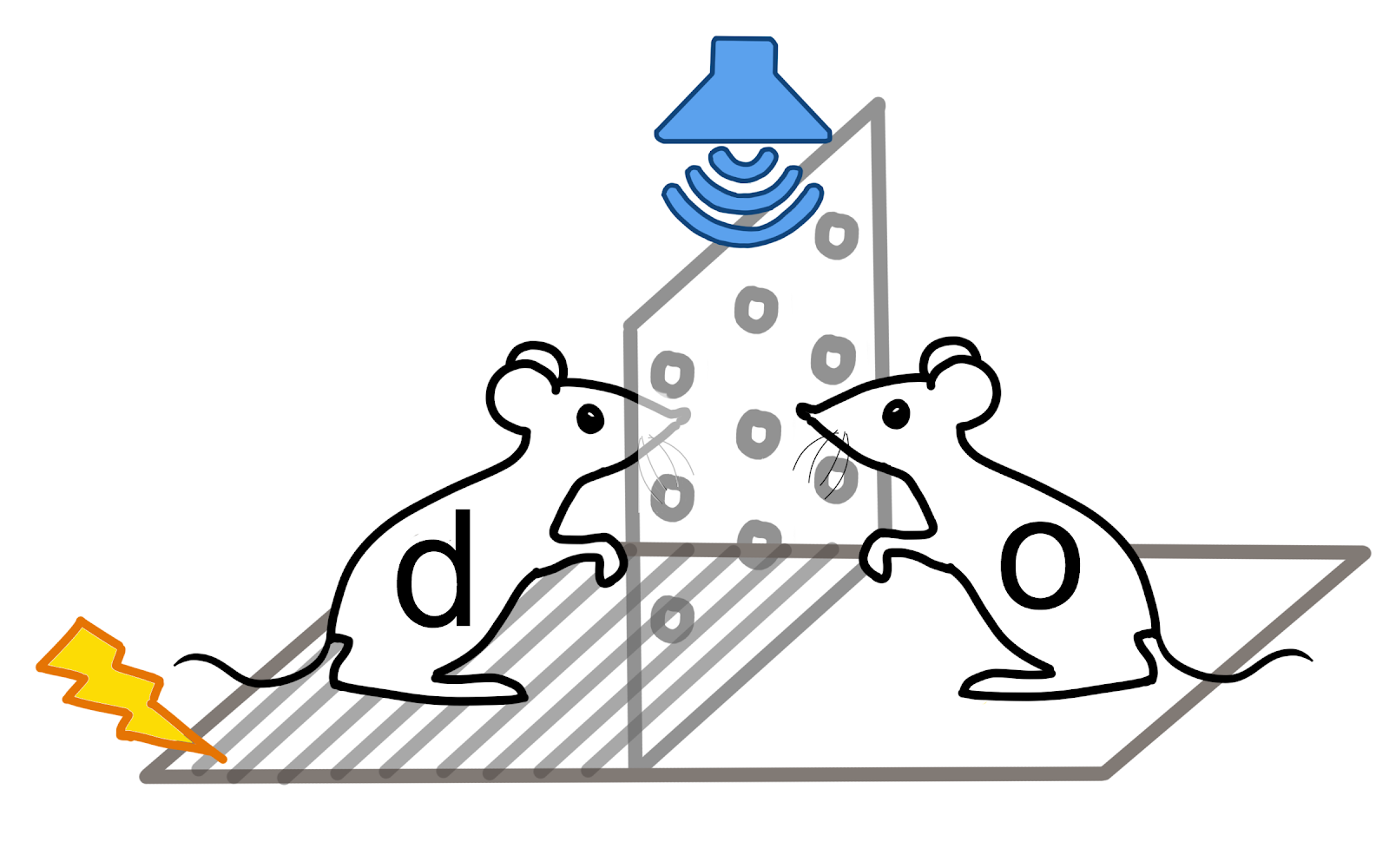
Clustering neural spiking data
Neural spiking data are an important source of information for understanding the brain. Analyzing the collective behavior of large assemblies of neurons brings further insight on how knowledge is acquired by humans and animals alike. In response to an external stimulus, sets of neurons often exhibit grouped response patterns. The identity of these neural groups -- as well as the highly nonlinear dynamics of their firing trajectories -- may inform us about how complicated emotions such as fear are encoded at the inter-neuronal level. From a machine learning perspective, we tackle this problem by viewing it as an instantiation of (nonlinear) time series clustering. We develop a general statistical framework and apply its methodology to answering a host of inferential questions in the neuroscience domain.
Relevant papers
[1]Lin A., Zhang Y., Heng J., Allsop S., Tye K., Jacob P., Ba D. "Clustering time series with
nonlinear dynamics: a bayesian non-parametric and particle-based approach", International
Conference on Artificial Intelligence and Statistics, 2019.
Main researchers: Alex Lin
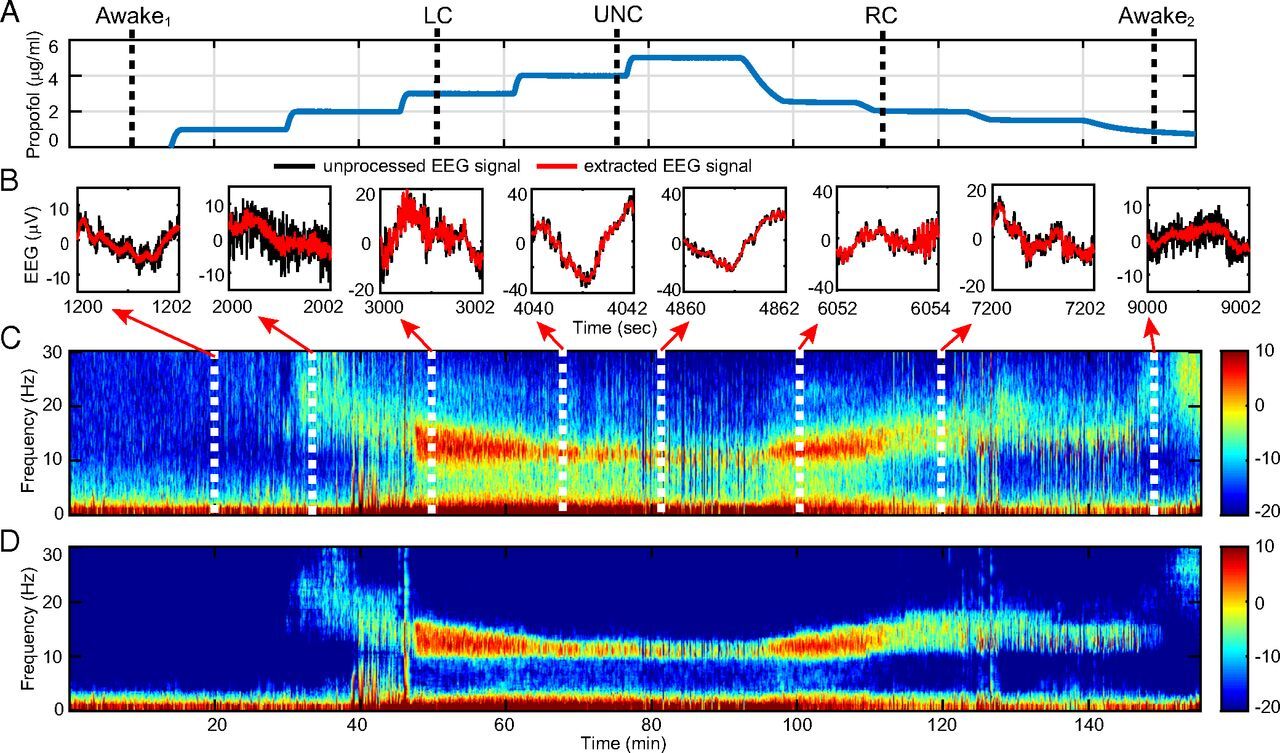
State-space multitaper time-frequency analysis
Rapid growth in sensor and recording technologies is spurring rapid growth in time series data. Nonstationary and oscillatory structure in time series is commonly analyzed using time-varying spectral methods. These widely used techniques lack a statistical inference framework applicable to the entire time series. We develop a state-space multitaper (SS-MT) framework for time-varying spectral analysis of nonstationary time series. We efficiently implement the SS-MT spectrogram estimation algorithm in the frequency domain as parallel 1D complex Kalman filters. In analyses of human EEGs recorded under general anesthesia, the SS-MT paradigm provides enhanced denoising (>10 dB) and spectral resolution relative to standard multitaper methods, a flexible time-domain decomposition of the time series, and a broadly applicable, empirical Bayes' framework for statistical inference.
Relevant papers
[1] Kim S-E., Behr M., Ba D., Brown E. "State-space multitaper time-frequency analysis",
Proceedings of the National Academy of Sciences, 2018.
Main researchers: Demba Ba
Teaching new tricks
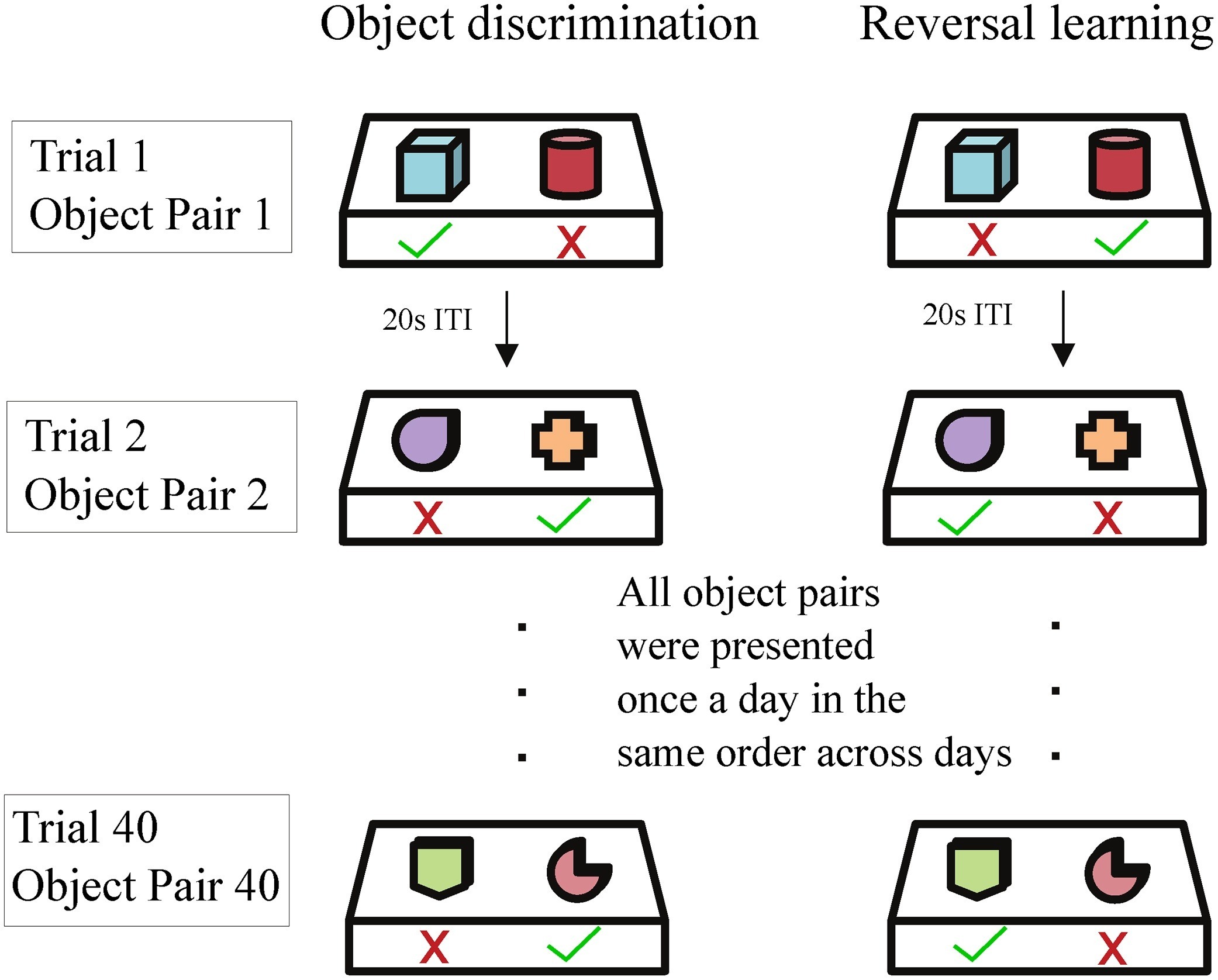
The study of learning in populations of subjects can provide insights into the changes that occur in the brain with aging, drug intervention, and psychiatric disease. Obtaining objective measures of behavioral changes is challenging since learning is dynamic, varies between individuals, and observations are frequently binary. We introduce a method for analyzing binary response data acquired during the learning of object-reward associations across multiple days. The method can quantify the variability of performance within a day and across days, and can capture abrupt changes in learning that would occur, for instance, due to reversal in the reward. The backbone of the method is a separable two-dimensional random field model for binary response data from multi-day behavioral experiments. We use data from young and aged female macaque monkeys performing a reversal-learning task that the model is well-suited for discriminating between-group differences and identifying subgroups.
Relevant papers
[1] Malem-Shinitski N., Zhang Y., Gray D., Burke S., Smith A., Barnes C., Ba D. "A separable
two-dimensional random field model of binary response data from multi-day behavioral
experiments", Journal of Neuroscience Methods, 2018.
[2] Malem-Shinitski N., Zhang Y., Gray D., Burke S., Smith A., Barnes C., Ba D. "Can you teach
an old monkey a new trick?", Computational and Systems Neuroscience, 2017.
Main researchers: Diana Zhang
Estimating a separably-Markov random field
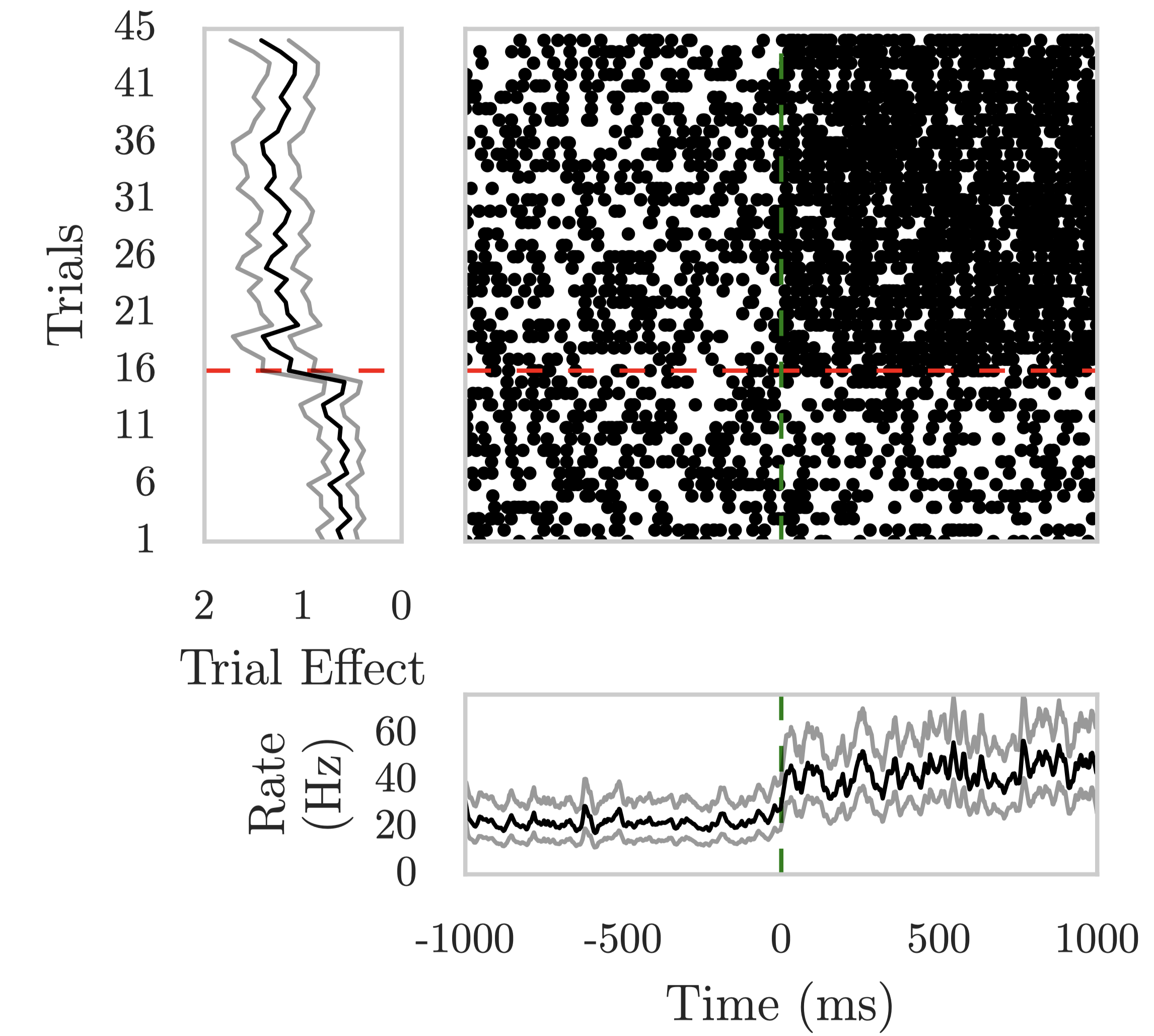
A fundamental problem in neuroscience is to characterize the dynamics of spiking from the neurons in a circuit that is involved in learning about a stimulus or a contingency. Classical methods to analyze neural spiking data collapse neural activity overtime or trials, which may cause the loss of information pertinent to understanding the function of a neuron or circuit. We introduce a new method that can determine not only the trial-to-trial dynamics that accompany the learning of a contingency by a neuron, but also the latency of this learning with respect to the onset of a conditioned stimulus. The backbone of the method is a separable two-dimensional random field model of neural spike raster. We develop efficient statistical and computational tools to estimate the parameters of the separable 2D RF model. We apply these to data collected from neurons in the prefrontal cortex in an experiment designed to characterize the neural underpinnings of the associativelearning of fear in mice.
Relevant papers
[1] Zhang Y., Malem-Shinitski N., Allsop S., Tye K., Ba D. "Estimating a separably-Markov random
field (SMuRF) from binary observations", Neural Computation, 2018.
[2] Zhang Y., Malem-Shinitski N., Allsop S., Tye K., Ba D. "A two-dimensional seperable random
field model of within and cross-trial neural spiking dynamics", Computational and Systems
Neuroscience, 2017.
Main researchers: Diana Zhang